Learning to do cool stuff when you’re no longer young and fearless sucks. But when you get it, it’s liberating. As a gymnastics coach, I can’t even begin to tell you how personally frustrating it is to teach a kid how to back-handspring in 3-7 days. Don’t get me wrong, I’m always super happy and proud of the kid, but at the same time super jealous. It took me 3 years to be able to do a back-handspring on the ground by myself. Even still, it’s a bit of a mental battle. I wish I was as fearless as some of these kids who aren’t afraid to just go for it. But I’m not. And it’s not just me. I see this all the time with people both older and younger than myself. Sometimes your brain says NO, sometimes your body does. Unless you are physically broken, your body is usually pretty easy to teach. It’s all a matter of stretching and conditioning. You’re brain, isn’t always so easy. In this article, we’ll teach your body something cool (nothing too crazy, just some handstands), and we’ll go over some techniques for dealing with mental blocks.

Back to basics
Progressions are always a great way to both teach something and deal with mental blocks. As a coach, being able to break down a skill and create progressions, is a powerful tool. This way, you can always make things easier, or more difficult depending on what skill or confidence level an athlete is at. Starting with the basics and building up is a great way to teach someone a new skill. While working in the opposite direction can help someone who is having a mental block come to terms with doing a more difficult skill. Being able to isolate the problem and pick a progression that deals directly with the part of a skill an athlete is having problems with, is a good way do deal with mental blocks.
Below, you will see some progressions used to learn a handstand. Once we have that down, we can get into some more complicated (cool looking) skills. I chose a handstand for this tutorial because it is part of the very basic building blocks of gymnastics, and, in my opinion, it’s the most important skills a gymnast can have as it translates to several other skills (like back-handsprings) and apparatuses. You also don’t need to be in a gym or have any large equipment to learn or work on handstands which is great.
Handstand progressions
Step 1
Basic Strength & Flexibility Requirements: At minimum, you should be able to do a BEAR WALK with straight arms and straight legs. This helps to ensure you have enough arm and shoulder strength that you won’t fall flat on your face, and that you have enough leg flexibility that you’ll be able to do at least a small kick up for your next progression.
- The advanced version of this is being able to do needle kicks *needle kicks require more leg flexibility*. Make sure you keep one foot planted on the floor.
- You should also be able to hold rigid shapes like front support (plank) or hollow. Teaching your body to have tight arms, core, legs, and butt.
Step 2
SAFETY: You shouldn’t go up until you know how to come down safely. This is to make sure you know what to do in the event that you kick to hard and fall out of your handstand. Try some “bail outs” from baby or mini handstands. DO NOT fall onto your back. I can tell you this will not feel nice and may injure you. Here are some good ones you should try:
- Come down to the side or cartwheel out
- Bring your knees to your chest and walk your hands forward (they’re not glued to the ground!)
- Move your hands forward and step down
- Advanced: Front roll out
- Advanced: Fall to bridge or front walkover
Step 3
Being Upside Down: This is just to get you used to being upside down and having your hips over your hands. These steps will help you with body alignment and help make it easier for you to balance. Be sure to keep your arms (or shoulders) covering your ears while looking at your hands the whole time.
- Walk feet up to tuck handstand or pike handstand against a wall or incline making sure that your hips are directly above your hands (facing the wall or incline)
- Teddy Bear Headstand, Advanced: Full Headstand (for body alignment and balance)
- Full Handstand (facing the wall or incline) Advanced: Facing wall with vertical alignment.
Step 4
Kicking Up: This is to help you get used to the motion of kicking up into handstand and getting used to how hard you need to kick until you get to vertical. Make sure your shoulders stay over top of your hands (especially when doing a handstand against a wall or incline) otherwise you’ll fall on your head!
- Lunge to “T” position. Straight arms covering ears.
- Needle pop or half handstand (same thing different names). Basically a needle kick where your other foot comes off the ground. Can be as big or small of a kick as athlete is comfortable with. Step back down one foot at a time. Advanced: Kick to a split and hold.
- Kick up to handstand against wall or incline (face facing out) Advanced: Handstand with only your head touching the wall or incline.
Step 5
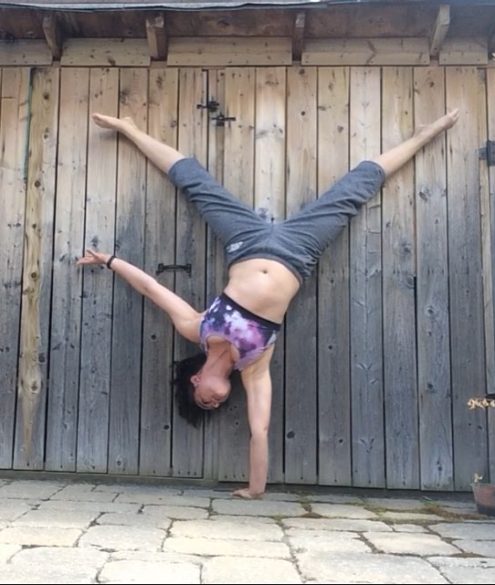
Free Standing Handstands: Use a spotter if you need. This one is the main event! Once you can hold a handstand for 10sec, try some of the variations in the image below!
- Needle pop or half handstand, bring feet together, and step back down. This is to help you figure out how much you need to kick free standing until you find your balance point.
- Kick to handstand and hold.
- Extend the amount of holding time 3, 5, 10sec. Advanced: 20, 30, 60sec.
Variations
Once you've mastered the basic handstand, adding variations is relatively easy! Contrary to what you might think, off balance handstands are easier than balanced and stationary ones. They look way cooler too!
Dealing With mental blocks
Mental blocks are always frustrating to deal with. As we have already gone through, breaking down a skill is one way to deal with mental blocks. Another thing I’ve noticed helps is to watch the skill you’re having trouble with several times.




Banksy artisan, crucifix cornhole actually mlkshk whatever flannel Shoreditch. Brooklyn sriracha typewriter Tumblr synth 8-bit hashtag direct trade. Craft beer post-ironic slow-carb mlkshk, Tonx Blue Bottle American Apparel organic put a bird…
Selvage bespoke readymade selfies. IPhone Thundercats commodo vinyl beard, keffiyeh sriracha.
Synth Cosby sweater trust fund, vegan fingerstache kogi chillwave fap disrupt Odd Future Tonx banh mi.